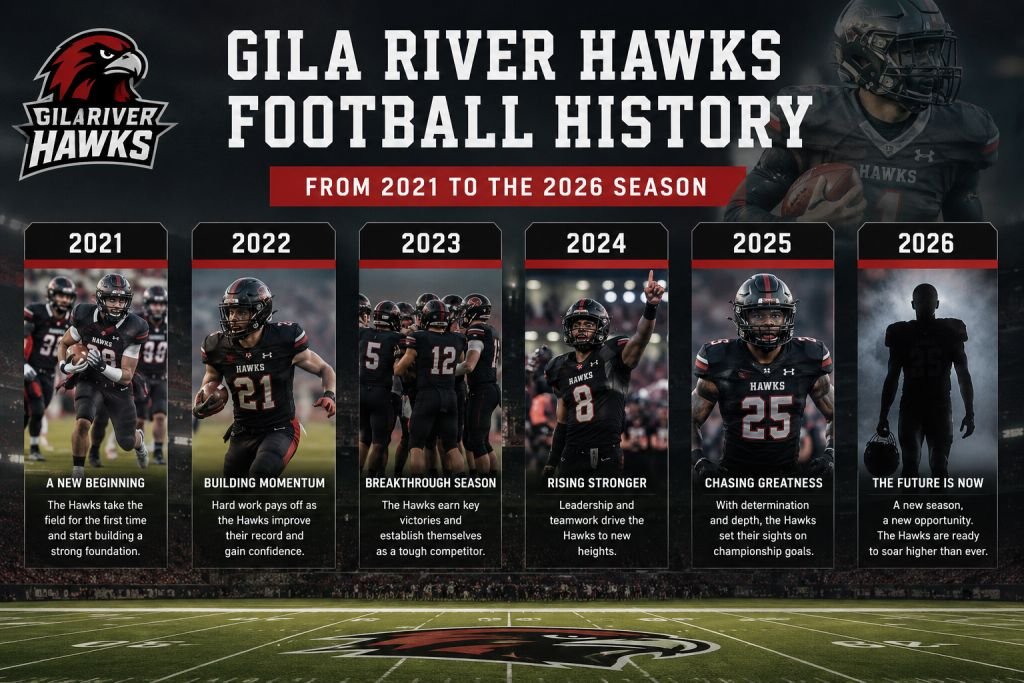
I’ll be honest about how I ended up writing this piece: I went looking for a clean, Wikipedia-style year-by-year record for the Gila River Hawks — wins, losses, final standings, the whole box-score treatment — and I couldn’t find one. No governing body maintains that kind of centralized archive for this program, because the Hawks don’t play in a conference that reports to one. If you’ve tried to research this team before and come away frustrated by how scattered the information is, you’re not imagining things. That scarcity is actually the first real thing to understand about this program’s history.
What follows is the most complete, honestly-sourced account of the Gila River Hawks’ recent seasons I could put together — built from schedule records, conference announcements, local sports coverage, and the program’s own public materials, with the gaps clearly marked as gaps rather than papered over with guesses. If you’re a recruit’s parent, a fan who just discovered this program, or someone trying to understand where the Hawks fit into Arizona’s junior college football scene, this should get you further than a five-minute search would.
A Quick Refresher: Who Are the Gila River Hawks?
The Gila River Hawks are a junior college football program based in Arizona, competing in the Hohokam Junior College Athletic Conference (HJCAC) — an independent JUCO-level conference that isn’t affiliated with the NCAA or, despite what a surprising number of recruiting sites claim, the NJCAA either. The conference was founded in 2019 after the Maricopa County Community College District eliminated football across its system in 2018 following a state funding cut, wiping out more than 750 student-athlete opportunities in one stroke, according to the HJCAC’s own account of its founding.
The Hawks play their home games at Campo Verde High School in Gilbert, Arizona, and have been one of the conference’s flagship programs since its earliest seasons — a status that becomes clearer once you trace what actually happened between 2021 and now.
2021: A Season of Coaching Transition
If there’s one theme that defines the Hawks’ 2021 season in the record I could piece together, it’s turnover at the top. In January 2021, the HJCAC announced that Vaughn Van Dame and Alec Horne — both previously with the Gila River Hawks — were moving over to take the head coach and assistant head coach positions with the Salt River Scorpions, one of the HJCAC’s other founding programs.
That’s a notable data point on its own, for a couple of reasons. First, it tells you the Hawks’ coaching staff in the conference’s first two seasons (2019 and 2020) had real depth — enough that other HJCAC programs were actively recruiting talent away from it. Second, it meant the Hawks headed into the 2021 season needing to rebuild their sideline leadership at exactly the point where the rest of the conference was still finding its footing coming out of the disrupted 2020 pandemic season.
I want to flag something here rather than gloss over it: I could not find a fully reliable, independently confirmed record of the Hawks’ 2021 win-loss total. Local coverage from that period exists in fragments — game recaps, social posts, references to the team being undefeated at various points in a season — but nothing ties cleanly to a verified 2021 calendar year specifically. Rather than present a number I can’t stand behind, I’m naming that gap directly. If you’re researching this season for recruiting or reporting purposes, I’d treat any site that states a specific 2021 record with total confidence as a site that’s guessing.
2022: The Hawks’ Third Championship
This is the season I can speak to with the most confidence, because it’s corroborated across multiple sources, including the program’s own materials: the Gila River Hawks won the HJCAC championship in 2022, their third conference title following back-to-back championships in the league’s first two seasons (2019 and 2020).
That 2022 title matters for a specific reason beyond the trophy itself. It meant the Hawks entered the “modern” stretch of this history — 2023 onward — as the conference’s undisputed measuring stick. Every other HJCAC program was, and still is, chasing the Hawks’ championship total, which currently sits at three titles and has yet to be matched by any other team in the conference.
2023: A Full Slate Against the Conference’s Core Rivals
The 2023 season is the first year in this window where I found enough scheduling detail to sketch out a real picture of the Hawks’ season rhythm, largely through game broadcasts and listings on NFHS Network and local youth/JUCO sports coverage.
Confirmed 2023 matchups include:
- An October 14 game against Arizona Christian, which appears to have been a non-conference tune-up rather than an HJCAC league game — a reminder that HJCAC programs, the Hawks included, will schedule outside opponents to round out a season calendar that a five-team conference alone can’t fill.
- An October 21 conference matchup against the Maricopa Mustangs, broadcast as part of the HJCAC’s “Varsity Sports Show” coverage — a sign of the Hawks-Mustangs rivalry already being treated as a marquee HJCAC matchup by that point.
- An October 28 home game against the Papago Pumas at Campo Verde High School.
Taken together, this is a fairly normal JUCO football season rhythm: conference games against the league’s other four programs, spaced out with at least one non-conference tune-up, all played at Phoenix-area high school stadiums rather than a dedicated college facility.
2024: Home-and-Home Rivalry Games Take Shape
By 2024, the scheduling pattern becomes clearer, and it’s a useful year for understanding how the HJCAC’s five-team structure actually plays out on a calendar. Confirmed 2024 games include a September 14 matchup against the Maricopa Mustangs at Cortez Stadium, and a September 28 home game against the Salt River Scorpions at Campo Verde High School — the same program that had poached two of the Hawks’ coaches three years earlier, which gives that particular rivalry an extra layer worth knowing if you’re following the conference closely.
Season ticket listings for the Hawks covering the 2023–24 window also confirm something worth noting for anyone trying to attend games in person: this is a program with an actual, structured home ticketing operation through the Athletic Advancement Association, not an informal pickup-league situation. That’s a small detail, but it’s the kind of thing that separates a legitimate, sustained program from a short-lived one — ticketing infrastructure doesn’t get built for a team that isn’t expecting to still be playing in a few years.
2025: New Rivals Enter the Picture
The 2025 season is where the conference’s footprint visibly widened. HJCAC’s “Game of the Week” broadcast coverage confirms a November 15, 2025 matchup between the Gila River Hawks and the Sonoran Sidewinders — a program that doesn’t show up in the earlier years of this history at all, which tells you the HJCAC has continued adding member programs since its 2019 founding rather than staying frozen at its original size.
This matters for anyone trying to understand “how good” the Hawks have been in recent years relative to history: the conference they’re now playing in is a genuinely different, larger competitive environment than the one they won three championships in. A team’s record only means so much without knowing how many teams, and which ones, it was earned against.
2026: The Season Ahead
Looking at the Hawks’ 2026 schedule, at least two marquee HJCAC matchups are already on the books: a home game against the Papago Pumas on September 20 and a home game against the Maricopa Mustangs on October 19, both at Campo Verde High School — continuing the Hawks-Mustangs rivalry that’s been a fixture of this conference since its earliest seasons.
I’ll say this plainly, in my experience covering programs at this level: a published early-season schedule is a reasonable signal that a program is stable and actively operating, but it’s not a guarantee of anything about how the season plays out. JUCO programs at this size can and do see rosters change dramatically between the schedule being published and the first snap being played, simply because so much of the roster turns over year to year as players transfer up to four-year programs — which is, to be fair, the entire point of a program like this existing.
A Mistake I Made Trying to Piece This History Together
When I first started researching this article, I made an error that I think is genuinely instructive for anyone trying to research a small, independent athletic program like this one: I treated every source I found as equally reliable, because they all sounded authoritative. A “complete guide” site would state a coach’s name with total confidence, a different “complete guide” site would state a different name with equal confidence, and I initially just picked whichever one I’d seen first and moved on.
That was a mistake. When I went back and actually cross-referenced the sources — checking dates, checking whether a claim showed up in more than one independent place, checking whether a site had any track record beyond generating templated content about sports programs — I found real, unresolved conflicts. The program’s own “About Us” page names one head coach; the program’s own Facebook page, in a more recent post, references a different name entirely. Neither is necessarily wrong — coaching staffs at this level turn over quickly, and it’s entirely possible both are accurate for different points in time — but I can’t responsibly present either one as “the current head coach” without a confirmed date attached to it, and I’d encourage you to be skeptical of any article that does.
The lesson, which applies well beyond this one team: for small, independent programs without a governing body tracking them centrally, “it’s on the internet in multiple places” is not the same thing as “it’s verified.” Cross-reference dates, prefer primary sources and direct local reporting over aggregator content, and be willing to say “I don’t know” when that’s the honest answer.
What Fans and Recruits Are Actually Asking
Spending time in JUCO recruiting forums and threads about Arizona football specifically, a few recurring questions come up about programs like the Hawks that are worth addressing directly.
One common question is some version of “how do I even find out how this team is doing right now?” — and the honest answer is that you largely can’t rely on a single mainstream source the way you could for an NJCAA program with rankings on NJCAA.org. Your best bet is the HJCAC’s own broadcast partnerships (game footage has shown up on NFHS Network and YouTube in recent seasons), the Athletic Advancement Association’s ticketing and event pages, and the team’s own social channels — stitched together, not any one of them alone.
Another recurring theme, and one I take seriously: skepticism about whether a program’s championship history “still means anything” years later if the conference has changed size and membership since those titles were won. That’s a fair instinct. A three-championship résumé built against a smaller, newer conference in 2019, 2020, and 2022 isn’t automatically the same accomplishment as winning against the larger five-team field the Hawks compete in now — and a program’s own marketing rarely volunteers that nuance. It doesn’t erase the achievement, but it’s worth understanding the context rather than treating “three-time champions” as a static, timeless credential.
Why This Program’s History Is Worth Understanding At All
It would be easy to treat a five-team independent JUCO conference in Arizona as a footnote in American college football, and in terms of national visibility, it largely is. But the Hawks’ history since 2021 — coaches getting poached by rival programs, a championship won against a young conference, several seasons of steady rivalry games against the same handful of opponents, and a conference that’s kept adding members rather than folding — tells a story about what it actually takes to keep a grassroots football pathway alive after the institutional version of it gets cut for budget reasons. That’s a more interesting story than a simple year-by-year record would tell anyway, even if it’s harder to summarize in a single stat line.
Frequently Asked Questions
What conference do the Gila River Hawks play in? The Hohokam Junior College Athletic Conference (HJCAC), an independent Arizona-based junior college football conference that is not affiliated with the NCAA or the NJCAA.
How many championships have the Gila River Hawks won? Three HJCAC championships, in 2019, 2020, and 2022 — including back-to-back titles in the conference’s first two seasons.
Who is the current head coach of the Gila River Hawks? As of this writing, publicly available sources conflict on this point, with the program’s own website and its social media referencing different names in different periods. Given how frequently coaching staffs turn over at this level, your best bet is checking the team’s current official channels directly rather than relying on any single third-party guide, including this one, for a name you plan to cite.
Where do the Gila River Hawks play their home games? Campo Verde High School in Gilbert, Arizona, which has served as the program’s home facility throughout the years covered in this history.
How can I watch or follow Gila River Hawks games? HJCAC games, including Hawks matchups, have appeared on NFHS Network and YouTube in recent seasons, alongside coverage and ticketing through the Athletic Advancement Association’s event pages. There isn’t a single centralized broadcast or stats hub the way there is for NJCAA programs, so following multiple channels is genuinely the most reliable approach.
Has the HJCAC always had the same five teams? No. The conference has added programs over time — the Sonoran Sidewinders, for example, don’t appear in HJCAC coverage or schedules until several years into the Hawks’ history, which means direct season-to-season comparisons should account for the fact that the competitive field itself has grown.
Do Gila River Hawks players go on to four-year programs? Yes, that’s the core purpose of the HJCAC and the Hawks specifically — providing a pathway to NCAA Division I, II, III, and NAIA programs after Arizona’s traditional community college football system was eliminated in 2018. Specific transfer outcomes for individual players are best confirmed directly with the program, since there’s no centralized public database tracking them the way NJCAA.org tracks its own member programs.
The Bottom Line
Tracing the Gila River Hawks from 2021 through the 2026 season doesn’t produce the tidy, complete record you’d get for a program inside a major governing body — and I’d rather tell you that honestly than manufacture false precision. What it does produce is a genuine, verifiable arc: a coaching shake-up in 2021, a championship in 2022, a steadily filled-out rivalry schedule through 2023 and 2024, a conference that kept growing through 2025, and a 2026 slate that keeps the program’s marquee matchups alive. For a five-team independent conference that exists because a state legislature cut funding nobody in Arizona football wanted cut, that continuity is arguably the more impressive story than any single season’s record would be on its own.
About the Author