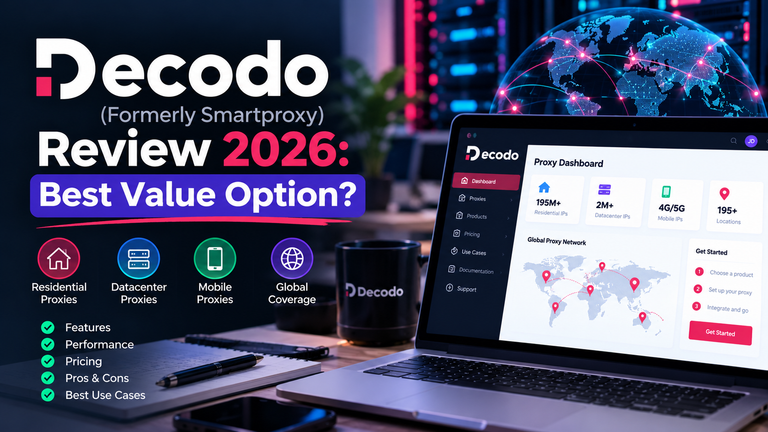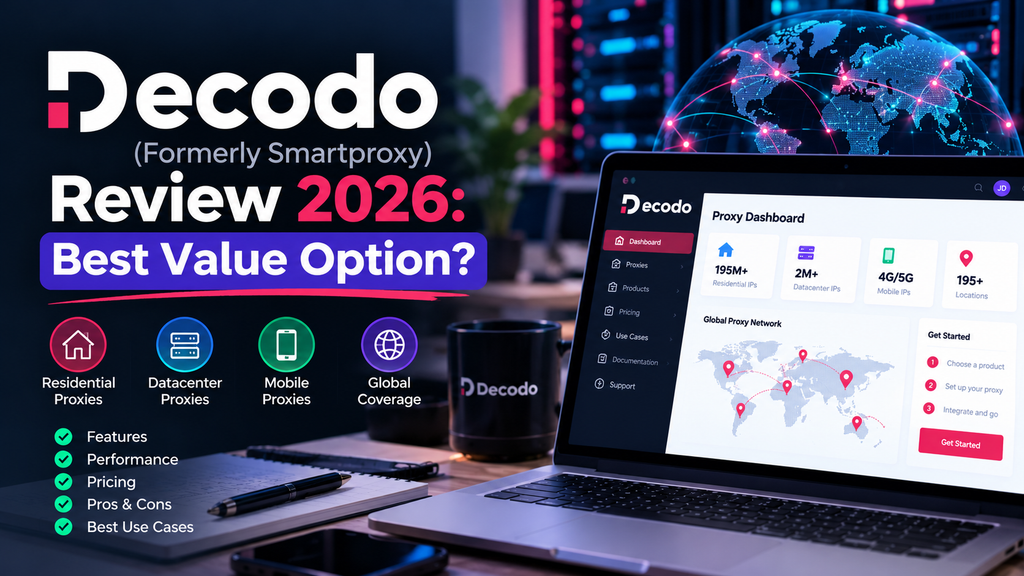
Smartproxy spent years as the proxy provider people recommended when Bright Data and Oxylabs felt like too much. Then it changed its name to Decodo, and a lot of buyers have since wondered whether the service changed with it. It didn’t. The network, dashboard and pricing structure carried over, so most older Smartproxy reviews still describe the same product.
The real question is whether Decodo is the best value in residential proxies, as its reputation suggests. This review covers what it sells, how its pricing really works (including a confusing inconsistency worth knowing about), what independent testing found, and who should choose it. If you are comparing providers, our roundup of the best residential proxy providers shows where it fits, and our guide to residential proxies covers the basics.
How this review was made: This is a research-based review, not a hands-on test. We compared Decodo’s published information with independent reviews and benchmark reports, most from 2026. Several sources are vendor-funded or competitors, and we flag that where it matters. Decodo’s prices and promotions change often, so check its site before buying.
The verdict in short
| Question | Short answer |
| Best for | Small and mid-sized teams, developers and agencies that want near-premium quality without enterprise contracts |
| Skip it if | You need the absolute deepest pool and a formal enterprise compliance package, or you want the lowest possible price per GB |
| Biggest strengths | Strong results in independent tests, self-serve signup, pay-as-you-go, 24/7 support, top-ups at the same rate |
| Biggest weaknesses | Confusing and inconsistent pricing, entry rates not the lowest, short free trial, smaller pool than the two giants |
| Verdict | A genuine value pick for most users, as long as you confirm the price at checkout |
Decodo at a glance
| Detail | What we found |
| Formerly known as | Smartproxy (rebranded to Decodo; the network, dashboard and pricing structure reportedly carried over) |
| Headquarters | Lithuania-based, according to a 2026 review |
| Advertised pools | 115M+ residential IPs, 10M+ mobile IPs, 500K+ datacenter IPs, 195+ locations |
| Proxy types | Residential, mobile, static residential (ISP) and datacenter |
| Other products | Site Unblocker, Web Scraping API, free tools |
| Protocols | HTTP(S) and SOCKS5 |
| Targeting | Continent, country, state, city, ASN, and ZIP code for US traffic, according to one review |
| Trial and refund | 3-day free trial with 100 MB of residential traffic; 14-day money-back on eligible plans |
| Support | 24/7, praised across reviews |
What Decodo sells
Residential proxies
This is the flagship product. Decodo advertises 115 million or more residential IPs, supports rotating and sticky sessions, and connects through gateway servers, with different ports for different locations. Proxyway describes it as built for accessing strict websites. The company says the IPs are ethically sourced, and TechRadar’s review states they are acquired with consent, though that is a claim we cannot independently audit. Ask for current documentation if sourcing matters to you.
One practical advantage is plan flexibility. Decodo lets you top up a plan at the same per-GB rate, so you are not forced to jump to the next tier when you run slightly over. That avoids a common frustration with providers whose overage rates are much higher.
Static residential (ISP), mobile and datacenter proxies
Static residential proxies pair a fixed IP from a real ISP with datacenter-like speed, which suits long sessions and account management. They are sold per IP, in shared and dedicated versions. Mobile proxies use 4G and 5G carrier IPs for mobile-first targets. Datacenter proxies are the cheap, fast option. Pricing for these varies by source and date, and reviews quote anything from a few tenths of a dollar per IP at volume to a few dollars at small quantities, so check the live pricing grid.
Site Unblocker and scraping tools
Site Unblocker is a proxy-like service that handles blocks and CAPTCHAs for you and is billed per request. Proxyway describes it as effectively a scraper dressed as a proxy. Sources quote roughly $1 to $1.60 per 1,000 requests depending on date and plan. There is also a Web Scraping API with its own 7-day free trial. As with any unblocker, use it only on hard targets, since easy sites cost far less through a plain proxy.
Performance: what independent testing says
As always, benchmarks depend on the target, timing and test design, and some are vendor-funded. Here is what the independent picture looks like:
- Pool size and depth. Proxyway’s April 2026 testing found Decodo’s residential network second only to Oxylabs in size and significantly larger than most competitors in its price range, with over 400,000 unique US proxies found. A separate vendor-run live-pool test measured 281,121 live IPs across five countries, within about 1% of the largest result, and found Decodo led four of the five countries.
- Success rate. Proxyway reported a success rate of 99.95% for the residential network in its test. Decodo’s own materials cite 99.86% and response times under 0.6 seconds. Treat vendor figures as marketing and your own test as the real answer.
- Speed. AIMultiple’s benchmark ranked Decodo first on speed with a 1.5-second average, though AIMultiple discloses that its research is funded by several proxy vendors, and that figure covers a mix of products.
- User sentiment. One review aggregator reports around 82% five-star ratings across more than 500 G2 reviews.
The common thread: Decodo performs close to the premium providers in most independent comparisons, at a noticeably lower price. That is the foundation of its value reputation.
Decodo pricing in 2026
Here is where you need to read carefully, because the sources disagree and Decodo’s pricing has moved over time. These are the figures that appear most often:
| Plan or product | What sources report | Note |
| Residential pay-as-you-go | About $3.50 per GB (Proxyway, G2 listing); $4 per GB (TechRadar, one 2026 review) | Older reviews cite $7 per GB, so make sure you read recent sources |
| Residential plans | Examples: $400 for 133 GB (about $3.00 per GB), up to $2,000 for 1 TB (about $2.00 per GB) | From TechRadar’s best-proxies roundup; older Smartproxy plans were pricier |
| Advertised ‘from’ rate | As low as $2 per GB | Applies only at high volume |
| Mobile | From about $4 per GB pay-as-you-go in one source, $8 to $9 in others | Sources conflict |
| Site Unblocker | Roughly $0.95 to $1.60 per 1,000 requests | Varies by plan and date |
| Free trial | 3 days with 100 MB of residential traffic; Scraping API has a 7-day trial | Short, and some sources say it is for one product only |
| Refund | 14-day money-back on eligible plans | Not available on every plan |
A pricing inconsistency to watch: One 2026 review noticed that Decodo’s own page listed $4 per GB on the pricing grid but $8.50 for 1 GB in the wallet FAQ. Whatever the cause, the lesson is simple: look at the total on the checkout screen before you pay, and screenshot it.
What this means in real money
Picture an illustrative buyer: a small SEO agency in Austin that collects about 100 GB of local search data a month. This is a hypothetical example, not a real customer.
- On a plan like $400 for 133 GB, using 100 GB means an effective rate of about $4.00 per GB (it would be $3.00 if you filled the whole allowance).
- On pay-as-you-go at roughly $3.50 to $4 per GB, 100 GB would cost about $350 to $400, if the per-GB rate holds at that volume. Confirm that before relying on it.
- For comparison, at the same 100 GB of use, the mid-level monthly plans at Bright Data and Oxylabs work out to about $5 per GB (see our reviews of each). Prices move, so recheck before deciding.
Retries and heavy pages change the picture. A provider with a high success rate and light pages costs less overall than a cheaper one that forces repeat requests. Our residential proxy pricing guide and our list of the cheapest residential proxies show how to compare on cost per successful request.
Compliance, KYC and sourcing
Decodo positions its residential pool as ethically sourced with user consent. Unlike Bright Data and Oxylabs, one competitor-published 2026 review reports it does not require KYC, which makes signup quicker for developers. That speed is a convenience but also a trade-off: if you need to show an auditor or client a formal vetting trail and compliance package, an enterprise provider is better equipped. We could not verify the no-KYC statement independently, so confirm it with Decodo.
A quick legal note: Using a residential proxy from a reputable provider is legal in most places, including the United States, but your use has to be lawful and consistent with each site’s terms. This is general information, not legal advice. See our guide to proxy legal considerations.
Support and ease of use
Support is a consistent highlight. Proxyway praises its 24/7 customer support, and Decodo’s dashboard and signup are described as friendly for newcomers. Setup follows the usual proxy pattern: a gateway address, credentials and optional parameters for location and session type. Reviewers do criticize the pricing model as complicated, since plans vary by product and units (GB, IP or request), which makes it harder to pick the right plan.
Pros and cons
| Pros | Cons |
| Near-premium performance in independent tests | Entry price is not the lowest; cheaper networks exist |
| Self-serve signup, pay-as-you-go available | Pricing inconsistent across its own pages and complicated across products |
| Large pool for the price (115M+ advertised) | Smaller than Bright Data and Oxylabs |
| Top-ups at the same per-GB rate | Free trial is only 3 days and 100 MB |
| Good targeting, HTTP(S) and SOCKS5 support | Refund not offered on every plan |
| 24/7 support, and 14-day money-back on eligible plans | Less formal compliance package than enterprise rivals |
Who should use Decodo, and who shouldn’t
A good fit
- Developers, agencies and small businesses that want reliable residential proxies without sales calls or KYC delays
- Teams with moderate, steady usage in the tens to hundreds of GB per month
- Buyers who want the option to start on pay-as-you-go and scale gradually
A poor fit
- Enterprises that need extensive compliance documentation, account management and the very deepest pool
- Extremely budget-driven buyers chasing the lowest per-GB rate, or those wanting traffic that never expires (look at IPRoyal)
- Anyone who needs a long free trial to evaluate
If you are leaning enterprise, read our Bright Data review and Oxylabs review. For budget flexibility, see our IPRoyal review.
How to try Decodo without overspending
- Use the 3-day trial first and run it on your real target URLs, not easy test pages.
- Check the price at checkout against the pricing grid before you pay, and keep a screenshot.
- Track success rate, response time and gigabytes used, then work out cost per successful page.
- Run the same URLs through one alternative to compare.
- Start on pay-as-you-go or a small plan, then move up only when your usage consistently fills it. Use the 14-day refund window if it applies to your plan.
Final verdict: is Decodo the best value?
For most small and mid-sized buyers, yes, or very close. Decodo delivers performance near the premium tier, a sizable pool, friendly onboarding and support that gets good reviews, at prices well below enterprise rivals. It is not the absolute cheapest and its pricing pages could be clearer, so the sensible approach is to verify the price at checkout and test on your own targets before committing. If the numbers hold, Decodo is the provider we would try first for a team without an enterprise budget.
Frequently asked questions
Is Decodo the same as Smartproxy?
Yes. Smartproxy rebranded as Decodo, and reviewers report the network, dashboard and pricing structure carried over.
Is Decodo good?
Independent tests rate its residential network highly for success rate, pool size and speed, and it is well reviewed by users. Results still depend on your targets, so run a trial.
How much does Decodo cost?
Residential pay-as-you-go is reported at roughly $3.50 to $4 per GB, with plans falling toward about $2 to $3 per GB at higher volume. Check the checkout total, since its own pages have shown inconsistent figures.
Does Decodo have a free trial?
Reviews report a 3-day free trial with 100 MB of residential traffic, a 7-day trial for the Scraping API and a 14-day money-back option on eligible plans. Terms change, so check the current offer.
Does Decodo require KYC?
One competitor-published review says no. Confirm with Decodo, especially if you need compliance documentation.
How big is Decodo’s residential pool?
It advertises 115M+ residential IPs. Independent tests found it second only to Oxylabs in size, though advertised figures are not audited counts.
Is Decodo better than Bright Data or Oxylabs?
It is cheaper and easier to start with, but smaller and with less formal enterprise compliance. For large or regulated operations, the two giants may suit better.
Can I use Decodo for web scraping?
Yes, it is widely used for that. Make sure your scraping is lawful and consistent with each site’s terms.
About the Author