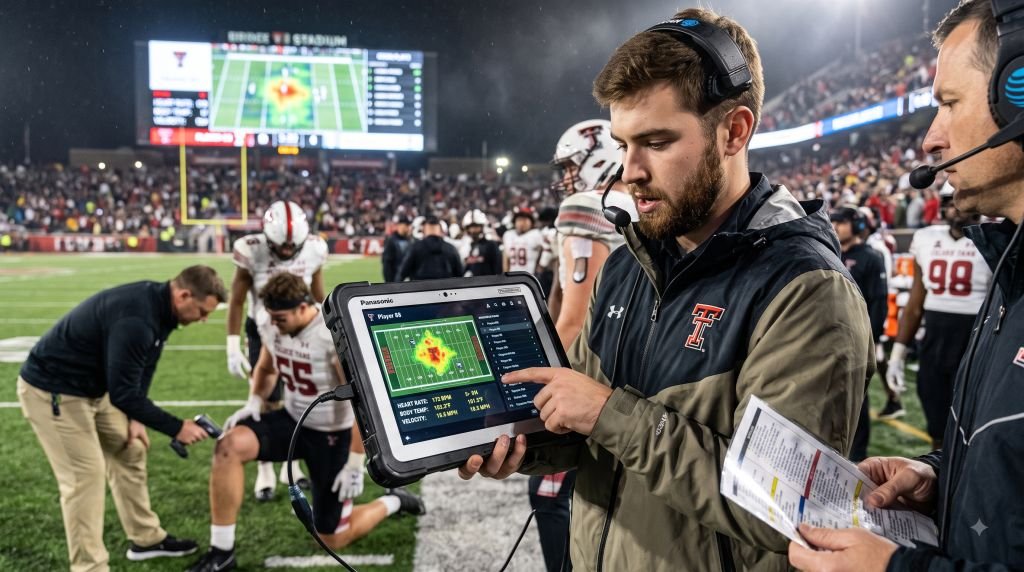
From GPS vests in practice to headsets under the chinstrap, the sport looks the same on Saturday and runs completely differently underneath.
A decade ago, if you’d told a college coach that his quarterback would have a coach’s voice piped directly into his helmet, that a freshman defensive back would review his own GPS data on a tablet after practice, or that a five-star recruit’s decision would hinge as much on an app-based NIL marketplace as on a campus visit, most of them would have assumed you were describing the NFL, not a Saturday in Athens or Ann Arbor. All three of those things are now just Tuesday in a major college football program.
The game itself — 11 players a side, four downs, a hundred yards of grass — hasn’t changed. Almost everything around it has. This guide walks through where technology has actually reshaped college football, separates the genuine advantages from the marketing hype, and includes an honest look at where the tech still creates as many headaches as it solves.
The short version
If you only have a few minutes, here’s where the real change has happened:
- Player tracking and wearables have turned practice planning from a gut-feel exercise into a data-informed one — GPS vests, heart-rate monitors, and motion sensors are now standard at the FBS level and increasingly common below it
- Coach-to-player helmet communication, approved by the NCAA for the 2024 season, replaced hand signals and sideline placards for the one “green dot” player per side — largely in response to Michigan’s 2023 sign-stealing scandal
- Sideline tablets now put real-time video review in players’ hands between series, something that simply didn’t exist a few years ago
- The transfer portal and NIL have become as much a technology story as a football one, with data platforms now tracking roster movement and NIL valuations the way recruiting sites once tracked star ratings
- Replay review remains deliberately conservative in college football — no “sky judge,” tight time windows, and a standard of indisputable video evidence — even as other levels of football experiment with more automation
- Fan-facing technology, from second-screen stats to in-stadium wayfinding, has changed how people experience a game day without changing what happens on the field
Wearables and player tracking: from gut feel to data
This is the least visible change and, in my view, the most important one. Programs across the country now equip players with GPS trackers, heart-rate monitors, and motion sensors during practice, capturing things like sprint distance, acceleration, top speed, and workload — the kind of data that used to live entirely in a coach’s memory and intuition.
The appeal is straightforward: this data lets a strength staff spot fatigue building in a player before it turns into a soft-tissue injury, and it lets position coaches compare how efficiently different players are actually moving, not just how fast they look on tape. What used to be a subjective call about whether to push a player harder or ease off in a Wednesday practice is increasingly grounded in a number on a screen.
The market reflects how normalized this has become. The wearable GPS tracking segment for sports is projected to grow at roughly a 14% compound annual rate through 2036 in North America alone, and vendors have shifted their focus from raw data collection toward simplified dashboards that a position coach — not just a sports scientist — can actually read and act on.
Case study: seeing the game through data
The following is an illustrative, composite scenario reflecting a type of experience commonly described by college defensive backs adapting to tracking technology. It isn’t a firsthand account from this article — it’s included because it captures, in a player’s own imagined words, exactly what this shift feels like at ground level.
“I used to think preparing for a football game was mostly about watching film, listening to my coaches, and trusting my instincts. Then our team started using more tracking and analytics technology, and I began seeing my performance in a completely different way. After one practice, I sat down with my tablet and looked at the data from our defensive drills. The GPS tracking showed how quickly I was moving, how much ground I covered, and how efficiently I was taking angles toward the ball. One number immediately caught my attention: I was consistently taking a longer path to the ball than some of the other defensive backs. At first, I didn’t like seeing it. I felt like the numbers were criticizing something I thought I was already good at. But when I watched the practice film alongside the tracking data, I could actually see the problem. I wasn’t necessarily too slow — I was taking inefficient angles. The next week, I changed how I approached the drills. Instead of simply trying to run faster, I focused on getting into position earlier and taking better angles. The technology didn’t replace my coach or my instincts. It gave us another way to understand what was happening on the field.”
What that scenario captures well is something that comes up constantly when you talk to people actually inside these programs: the data doesn’t replace coaching or instinct, it gives both of those things something concrete to work with. A coach telling a player to “take a better angle” is vague. A coach showing a player the exact GPS path they took, next to a teammate’s more efficient one, is specific and hard to argue with. That’s the real shift — not more information for its own sake, but information that connects to something a player can actually feel and correct.
Coach-to-player communication: solving one problem, creating a few new ones
For thirty years, the NFL had something college football didn’t: a direct line from the sideline into a player’s helmet. College programs relied on hand signals, oversized placards, and — as the 2023 Michigan sign-stealing scandal made painfully clear — a system that was vulnerable to exactly the kind of exploitation that direct communication would prevent.
The NCAA approved coach-to-player helmet communication starting with the 2024 season, closely mirroring NFL rules: one offensive player and one defensive player per team, marked with a green dot on the helmet, with communication cutting off when the play clock hits 15 seconds or the ball is snapped, whichever comes first. Sideline and press-box tablets arrived alongside it, letting coaches and players review real-time video between series and even at halftime.
The rollout hasn’t been seamless. In its first season, ESPN reported real growing pains — Oklahoma quarterback Jackson Arnold was seen holding his hands over his helmet trying to hear signals during a home game, and his coach later called the communication “a little bit inconsistent.” A more serious issue surfaced in October 2024, when it emerged that coach-to-player communications for several Big 12 teams were running on unencrypted frequencies — technically interceptable by anyone with a scanner and the know-how to find the right channel. The conference required an equipment recall and software update, and its subsequent review found no games had actually been compromised, but it was a reminder that bolting NFL-style technology onto a sport with 130-plus FBS programs and wildly different budgets doesn’t happen without friction.
There’s also a tactical wrinkle that doesn’t get enough attention: helmet comms help offenses more than defenses. An SEC defensive coordinator told CBS Sports that with only one defensive player wired in, there’s no way to “huddle” the way an offense effectively can through its quarterback — defenses still rely heavily on sideline signals precisely because a single green-dot linebacker can’t relay a full defensive call to ten other players before a fast-tempo offense snaps the ball.
Common questions about helmet communication
- Does every player get a headset? No — only one offensive and one defensive player per team, identified by a green dot on the helmet
- Can defenses use it as effectively as offenses? Not really, and multiple coaches have said so publicly — the single-player limit makes it much harder to relay a full defensive call than an offensive play
- Is it secure? It’s supposed to be, but a 2024 encryption gap across Big 12 teams showed the system isn’t foolproof out of the gate
The transfer portal and NIL: technology reshaping the roster-building process itself
It’s easy to think of NIL and the transfer portal as legal and financial stories rather than technology ones, but the infrastructure underneath both is unmistakably tech-driven. Compliance now runs through platforms like NIL Go, where the College Sports Commission requires that third-party NIL agreements over $600 be formally reported and shown to reflect legitimate promotional activity rather than being disguised pay-for-play. Separate data platforms now track NIL valuations and portal movement across every Division I program the same way recruiting sites once tracked star ratings — you can look up a program’s aggregate NIL roster value about as easily as you can look up its win total.
The scale of what these systems now manage is significant. Beginning with the 2026 cycle, college football moved to a single primary transfer window, running January 2–16, with a short additional window for teams in the College Football Playoff. In that compressed window alone, more than 4,500 college football players entered the portal — somewhere between a quarter and 30 percent of all scholarship athletes in the sport, according to reporting compiled by NIL Club. Managing that much roster movement, across that many programs, in a two-week span, is simply not something athletic departments could coordinate on spreadsheets and phone calls the way they might have a decade ago.
What this means practically for a program: recruiting staffs increasingly function like small-scale front offices, using data platforms to track not just who’s available in the portal but what they’re likely to command in NIL value, how that compares to the roster spot they’d fill, and how much runway is left in the signing window before a competing program locks that player up. Coaches now describe spending more time managing retention, portal evaluation, and NIL expectations than they do on-field development — a direct consequence of how fast and how visible this new market has become.
Instant replay and officiating: deliberately behind the times, and mostly on purpose
If you follow the NFL, you might expect college football to be racing toward automation — chip-tracked first downs, AI-assisted offside calls, that kind of thing. It largely isn’t, and that’s a deliberate choice, not a lag.
College football’s replay assist system, introduced in 2021, allows a replay official to make quick corrections on clearly reviewable plays, but only within a tight window — the official has until the play clock reaches 20 seconds to intervene, and that window shrinks further if the offense is hurrying to the line. There’s no “sky judge” role like some spring and developmental leagues have experimented with; the standard remains “indisputable video evidence,” and replay officials describe their job less as officiating and more as evaluating whether the evidence clears a genuinely high bar.
The numbers back up how rarely this actually interrupts a game. In the Big Sky Conference during the 2025 season, replay crews conducted 87 formal reviews across 68 conference-officiated games — an average of just 1.3 stoppages per game. That’s a useful reminder that even with far more video technology available than a decade ago, the sport has chosen restraint over maximal intervention, largely because up-tempo offenses leave almost no time for a lengthy automated review before the next snap.
Film study: the quiet revolution nobody argues about
Ask anyone who’s worked in a college football video department for 20-plus years, and they’ll tell you the biggest technological shift wasn’t flashy at all — it was the death of physically swapping game film. Programs used to exchange tape by driving to meet another school’s staff halfway, or by shipping a box of Betacam tapes on a commercial flight and waiting at the airport for it to arrive. Georgia Tech’s longtime director of video operations, who started in the role in 1998, has described editing film for three or four hours after every practice before coaches could see anything.
Now, film from a college practice can be cut and delivered to coaches within about five minutes of the session ending, and teams share game footage over the internet almost instantly instead of over commercial flights. This isn’t a controversial or debated change the way helmet comms or the transfer portal are — it’s simply accepted as one of the clearest wins technology has delivered to the sport, freeing up hours per week that used to disappear into logistics.
What Reddit and college football forums actually talk about
Spend time in college football communities online and the conversation about technology skews less toward “is this good or bad” and more toward “is this fair.” A recurring theme, especially in threads about helmet communication, is frustration that budget still determines who benefits most — reports have put the cost of full helmet-comm and tablet systems at roughly $40,000 per program, a number that’s a rounding error for a Power 4 athletic department and a real constraint for a Group of 5 or FCS program trying to keep up.
A second recurring theme is skepticism about whether officiating technology is actually being used to its full potential. Fans regularly point to close calls that “felt” wrong even when replay officials ruled there wasn’t indisputable evidence to overturn them — which is less a technology failure than a reminder that the standard itself is intentionally conservative. And in NIL-focused communities, a common question boils down to: how do you evaluate whether a transfer portal addition is actually worth what a collective is paying, when the valuation data is still relatively new and inconsistent across platforms? That’s a fair question, and one the industry itself is still working out — even the compliance bodies overseeing NIL reporting have acknowledged they have limited ability to police deals structured through entities outside their direct authority.
The fan experience: the part that gets the least credit
Most of what’s covered so far happens on the field or in a compliance office, invisible to the person watching from the upper deck or their couch. But technology has changed game day for fans too, even if it’s the part of this story that gets the least attention. Second-screen apps now layer real-time win-probability models and advanced stats over a broadcast that used to just show you the score and the down-and-distance. In-stadium apps handle everything from mobile ticketing to concession ordering to wayfinding in stadiums that can hold 100,000-plus people. None of this changes what happens between the hashmarks, but it’s a meaningful part of why the sport feels different to consume than it did ten years ago.
What this means if you’re trying to keep up with the sport
- Don’t assume every program has equal access to this technology — cost remains a real divider, and a Group of 5 program’s tech stack often looks meaningfully different from a Power 4 program’s
- Treat NIL valuation numbers you see online as estimates, not verified figures — the reporting infrastructure is new and still maturing, even as the dollar amounts get more attention
- Expect officiating technology to stay conservative relative to other sports — the sport has consistently prioritized game pace over maximal review, and that’s unlikely to change soon
- If you’re a player or parent evaluating a program, it’s worth asking directly what tracking, film, and communication technology the program actually uses day to day — the answer varies more between schools than most recruiting coverage lets on
Where this is likely headed next
None of the people actually building this technology — from GPS vendors to NIL compliance platforms — describe it as a finished product. Wearable systems are moving toward simpler dashboards that don’t require a sports-science degree to interpret. Helmet communication is likely to expand beyond a single defensive player once the encryption and reliability issues from its first seasons are fully ironed out. And the infrastructure around NIL and the transfer portal will keep maturing as the College Sports Commission continues tightening enforcement around how deals get reported and verified.
What’s unlikely to change is the sport’s basic caution about full automation in officiating, and its reliance on human judgment layered on top of better information almost everywhere else. That balance — more data, same human decision-makers — is probably the most accurate one-sentence summary of where college football’s relationship with technology actually stands in 2026.
Frequently asked questions
When did college football add helmet communication?
The NCAA approved coach-to-player helmet communication for the 2024 season, following a successful trial during the 2023 bowl season. It mirrors NFL rules, with one offensive and one defensive player per team allowed a helmet radio, cutting off at the 15-second mark of the play clock or the snap, whichever comes first.
Why did college football add helmet communication in the first place?
The most immediate trigger was the 2023 Michigan sign-stealing scandal, which exposed how vulnerable hand-signal and placard-based play calling was to advance scouting. Direct communication removes most of the incentive to steal signs in the first place.
Does helmet communication help offenses or defenses more?
Offenses, by most coaches’ accounts. A defense can only wire in one player, which makes it hard to relay a full defensive call the way a quarterback can relay an offensive one — defenses still lean heavily on sideline signaling as a result.
How is the transfer portal connected to technology?
Largely through the data and compliance infrastructure now required to track it — NIL valuation platforms, portal-tracking databases, and formal reporting systems like NIL Go, which the College Sports Commission uses to monitor third-party NIL agreements over $600.
Does college football use the same replay technology as the NFL?
Not exactly. College football uses a replay assist system introduced in 2021 with a tighter time window and no “sky judge” role, reflecting a deliberately more conservative approach to in-game review than some other levels of football.
About the Author