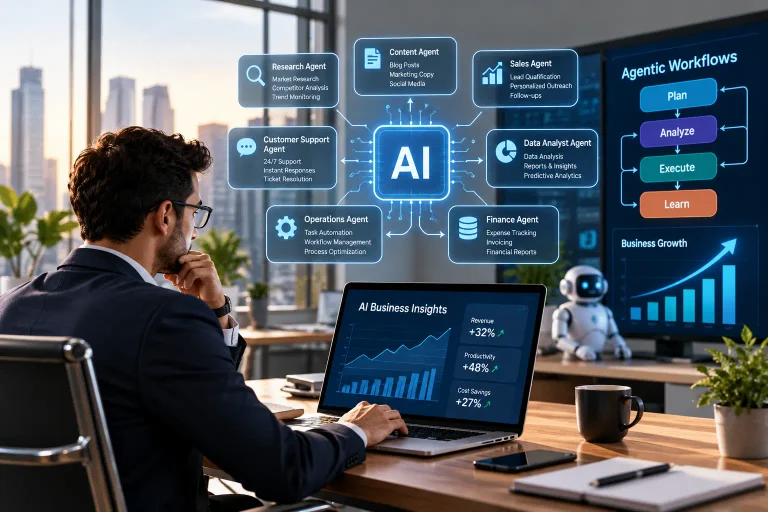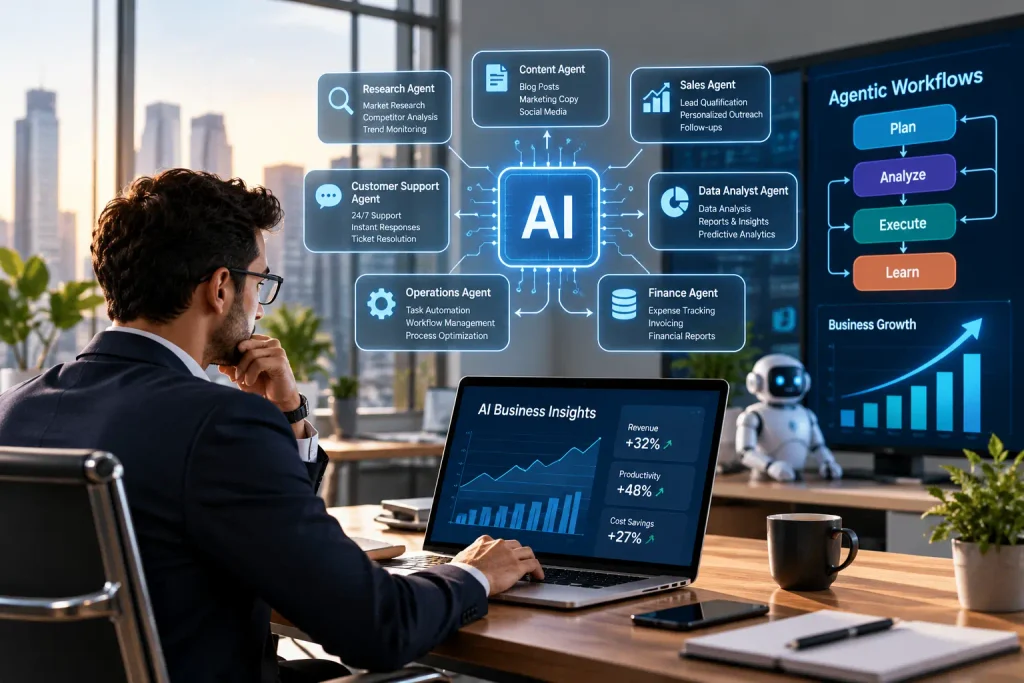
Artificial intelligence is no longer an experimental technology in business. In 2026, it has become embedded in everyday operations—from customer support and finance to software development, cybersecurity, and supply chain management. But the most significant shift is not adoption itself. It is the redesign of workflows around AI, moving from isolated task automation toward agentic systems that can coordinate multiple steps, call tools, and operate within governed boundaries.
The data confirms this transition is real but uneven. McKinsey’s 2026 State of AI survey found that 89% of organizations use AI in at least one business function, and 44% have scaled AI across the enterprise, up from 38% a year earlier . Yet only 6% report generating significant value from AI, and just 37% see a positive contribution to operating profit—unchanged from 2025 . The gap between adoption and measurable return is the defining challenge for business leaders this year.
What Are AI-Powered Business Operations?
AI-powered business operations means using artificial intelligence to improve, automate, analyze, or coordinate the processes that keep an organization running. These processes span customer service, sales, finance, human resources, supply chain, procurement, software development, cybersecurity, and internal knowledge management.
Traditional automation follows predefined rules: when an invoice arrives, extract information, then send it to accounting. AI-powered automation can work with less structured information—interpreting language, classifying documents, identifying patterns, and assisting with decisions. This means businesses can automate parts of workflows that previously required manual interpretation.
Effective implementation, however, does not mean removing people from every process. The better approach is determining which tasks AI can handle reliably, which require human approval, and where employees and AI work together.
Why AI Is Transforming Business Operations in 2026
The business conversation around AI has changed. A few years ago, companies asked: Can AI do this? Today, the question is: How can we integrate AI into the way we already work?
Current research points toward AI agents, workflow automation, and production deployment rather than isolated experiments. Google Cloud’s 2026 research describes a move toward agentic workflows in which AI systems coordinate across multiple steps and tools . Deloitte’s 2026 survey found that close to three-quarters of companies plan to deploy agentic AI within two years, yet only 21% report having a mature governance model for it . That gap—between ambition and oversight—is where most operational risk now resides.
A company does not need AI everywhere. It needs AI where it can create measurable improvement.
1. AI Is Automating Repetitive Business Tasks
One of the most practical applications of AI remains reducing repetitive work. Employees spend significant time reading and sorting emails, processing documents, entering information, creating routine reports, searching for internal information, and classifying customer requests.
AI-powered document workflows can receive an invoice, extract relevant information, identify the supplier, classify the document, check required fields, and send structured information into another business system. Instead of manually processing every document, an employee focuses on exceptions and approvals.
The goal is not necessarily to replace an entire department. It is to remove repetitive steps so employees can spend more time on work requiring judgment, communication, creativity, and expertise.
2. AI Agents Are Taking Business Automation Further
AI agents represent the most important development in business operations in 2026—and the most hyped. A traditional chatbot responds to a question. An AI agent can pursue a specific objective across multiple steps using approved tools and information: receiving a new lead, reviewing customer data, classifying the lead, preparing a personalized message, updating the CRM, requesting human approval where required, scheduling follow-up, and recording the activity.
The distinction matters because much of what is marketed as “agentic” today remains single-step automation wrapped in agent language . Gartner projects that 40% of enterprise applications will embed task-specific AI agents by the end of 2026, up from under 5% a year earlier—an eightfold jump . But Gartner also expects more than 40% of agentic AI projects to be cancelled by the end of 2027, citing escalating costs, unclear business value, and inadequate risk controls—not model quality .
Businesses should not give an AI agent unrestricted authority simply because it can perform a task. Agent permissions should match the risk of the workflow.
3. AI Is Moving From Pilots to Production
Many businesses have already experimented with generative AI. The next challenge is turning successful experiments into reliable production systems. A production AI system needs reliable data, clear workflows, system integrations, security controls, monitoring, testing, human oversight, and performance measurement.
Deloitte’s research identifies this movement from experimentation toward production as a major theme, but the numbers reveal how difficult the transition remains. Only 25% of Deloitte respondents have moved 40% or more of their AI pilots into production . McKinsey found that only around 23% of organizations are scaling an agentic AI system anywhere in the enterprise, while roughly two-thirds remain in experimentation or pilot mode .
This creates three levels of AI adoption: experimentation (testing what AI can do), implementation (connecting AI to a real business workflow), and transformation (redesigning how the business operates around AI). The third stage is where the larger operational opportunity exists—and where the fewest companies have arrived.
4. AI Is Improving Business Decision-Making
Modern businesses generate enormous amounts of information: sales data, customer conversations, financial records, website activity, support tickets, inventory data, and operational reports. The challenge is often not collecting information but understanding it quickly enough to make useful decisions.
AI can analyze large datasets, identify patterns, summarize information, detect anomalies, and help employees find relevant information. For example, an organization could analyze thousands of customer support conversations to identify the most common problems, then use those insights to improve the product, documentation, or internal processes.
AI can also make business data easier to interact with. Instead of manually searching through multiple reports, an authorized employee could ask: “Which customer issues increased this quarter, and which products are most affected?” A properly designed system could retrieve relevant information and present an analysis. The final decision, however, should remain with the appropriate business decision-maker when judgment or accountability is required.
5. AI Is Transforming Customer Service
Customer support is one of the clearest applications for business AI. AI can assist with frequently asked questions, support ticket classification, ticket routing, knowledge-base search, response drafting, conversation summaries, customer intent detection, and escalation identification.
A customer asking a routine question can receive an immediate response based on approved company information. A complex request can be transferred to a human representative with the conversation already summarized. This creates a hybrid model: AI handles repetitive information-based interactions, while employees handle situations requiring judgment, empathy, negotiation, or exception handling.
Deloitte’s survey identifies customer support as the function expected to see the highest impact from agentic AI, with an air carrier example using agents to help customers rebook flights or reroute bags, freeing human agents for more complex matters .
6. AI Is Changing Sales and Marketing Operations
Sales teams can use AI to research prospects, summarize customer conversations, classify leads, prepare outreach, identify follow-up opportunities, update CRM information, and prioritize potential opportunities. Marketing teams can use AI for customer research, audience analysis, campaign planning, content assistance, customer segmentation, performance analysis, and personalization.
But producing more content is not the same as creating more business value. The stronger use of AI is connecting it with customer information, business objectives, marketing systems, and measurable outcomes. An AI system could analyze customer behavior and help a marketing team identify which segments are responding to particular offers. AI then becomes part of the decision-making process rather than simply a content-generation tool.
7. AI Is Transforming Finance and Accounting
Finance teams manage large volumes of structured and unstructured information. AI can support invoice processing, expense classification, document extraction, financial reporting, transaction analysis, anomaly detection, forecasting assistance, and internal financial knowledge search.
Consider invoice processing. A traditional workflow may require an employee to open each document, identify relevant information, enter the data, and route the invoice for approval. An AI-powered workflow can extract information automatically and send structured data into an accounting process. Employees then focus on reviewing exceptions and making approvals.
Because finance involves sensitive information and potentially high-impact decisions, AI systems should have appropriate access controls, audit trails, validation, and human oversight.
8. AI Is Improving Human Resources Operations
Human resources teams manage many information-heavy workflows. AI can assist with employee onboarding, policy questions, internal knowledge search, document processing, scheduling, training recommendations, request classification, and employee support.
An internal AI assistant can help employees find information from approved company policies. Instead of searching through multiple documents, an employee could ask: “What is our remote-work policy?” The system retrieves relevant information and presents it in a conversational format.
However, sensitive employment decisions should receive appropriate human oversight. AI can support HR professionals, but accountability for important decisions should remain with qualified people.
9. AI Is Optimizing Supply Chain and Operations
Supply chains generate large amounts of continuously changing information. AI can support demand forecasting, inventory analysis, route planning, delivery monitoring, exception detection, operational reporting, and supplier analysis.
An AI system can analyze operational data and identify unusual delivery delays or changes in demand. Operations teams can then investigate those issues earlier. AI can also help identify patterns that may be difficult to detect manually across large datasets.
However, supply-chain AI is only as reliable as the underlying information. Incorrect inventory records, outdated supplier data, or incomplete operational information can produce unreliable outputs. That makes data quality a fundamental part of AI implementation.
10. AI Is Accelerating Software Development
AI is changing software development from coding assistance to broader engineering support. Developers can use AI for code generation, debugging, code explanation, test generation, documentation, refactoring, technical research, and code review assistance.
This can reduce the time required for certain development tasks. However, AI-generated code still needs engineering review. Software architecture, security, scalability, performance, testing, infrastructure, and business requirements cannot simply be delegated without appropriate oversight. The practical model is not AI replacing software engineers—it is engineers using AI as an additional development capability.
Software engineering and IT operations consistently appear as the leading real-world use case for agentic systems, because coding tasks are well-defined and testable compared to open-ended business processes .
11. AI Is Strengthening Cybersecurity Operations
Cybersecurity teams process enormous amounts of information: security logs, alerts, access events, and unusual activity. AI can assist with threat detection, anomaly detection, security alert prioritization, log analysis, incident investigation, security reporting, and response assistance.
AI can help security teams identify patterns and prioritize potentially important events. But an AI system with access to security infrastructure must be carefully controlled. Organizations should define what the system can see, what it can change, what actions require approval, and how actions are recorded.
12. AI Is Making Business Software More Intelligent
AI is increasingly becoming part of the software businesses already use. Instead of opening a separate AI application, employees interact with AI directly inside CRM systems, ERP platforms, SaaS applications, analytics platforms, and customer portals.
For example: a CRM summarizes customer history; an analytics platform explains important changes in business metrics; an operations platform identifies exceptions; an internal application retrieves approved company information; a customer portal helps customers complete common tasks. This makes AI part of the actual product experience—and for companies developing software products, an opportunity to design AI capabilities directly into the product architecture.
13. AI Is Creating New Digital Products
AI is not only improving existing workflows. It is also enabling new digital products: AI-powered SaaS platforms, intelligent customer portals, AI assistants, recommendation systems, predictive analytics products, computer vision applications, AI automation platforms, and industry-specific AI software.
The strongest opportunities generally begin with a genuine customer problem. Instead of asking “What AI feature can we add?”, product teams should ask: “What problem becomes easier or more valuable because AI exists?” That question helps businesses build products around actual customer needs rather than technology trends.
14. AI Is Moving From Task Automation to Workflow Automation
One of the biggest changes in business AI is the movement from automating individual tasks toward automating complete workflows. Traditional automation might handle one step: receive invoice, extract information. AI-powered workflow automation can potentially coordinate several steps: receive invoice, understand information, validate details, identify exceptions, route for approval, update system, notify employee.
This difference matters because businesses do not operate as collections of isolated tasks. They operate through interconnected processes. That means the greatest opportunity may come from redesigning the complete workflow rather than adding AI to one individual step. Current 2026 research increasingly emphasizes this transition toward end-to-end process redesign and agentic workflows .
15. AI and Data Quality Go Hand in Hand
AI cannot magically fix unreliable business data. Before implementing an AI system, organizations should understand where data comes from, which sources are trusted, how information is updated, who can access it, how systems exchange information, which data can be used by AI, and how outputs will be evaluated.
This becomes even more important when AI agents are connected to business systems. An agent connected to incorrect information can produce incorrect results. An agent connected to outdated information can make outdated recommendations. An agent with excessive permissions can create unnecessary security or operational risks. AI strategy therefore needs to include data strategy.
16. AI Governance Is Becoming More Important
As AI systems become more capable, businesses need greater control over how those systems operate. Important governance questions include: What information can AI access? Which systems can it connect to? Which actions can it perform? Which actions require approval? How are AI actions logged? How are errors detected? How are outputs evaluated? Who is responsible for the result?
Deloitte’s survey found that only 21% of organizations report having a mature governance model for agentic AI, even as 74% expect to use agents at least moderately by 2027 . The same research found that companies succeeding with agentic AI take a measured approach: starting with lower-risk use cases, building governance capabilities, and scaling deliberately.
A simple principle is useful: the more authority an AI system has, the stronger its controls should be.
17. What AI Should and Should Not Automate
Not every business process is equally suitable for AI automation. AI is generally more suitable when a process is repetitive, high-volume, data-driven, well-defined, measurable, relatively predictable, and easy to verify. Document classification, for example, can be a strong candidate.
A high-risk decision involving sensitive financial, legal, medical, or employment consequences may require much stronger human oversight. Businesses should evaluate AI opportunities based on both potential value and potential risk. The objective is not maximum automation. The objective is appropriate automation.
18. Why Some AI Projects Fail to Scale
An AI demonstration can look impressive while the underlying business process remains unsuitable for production. Common problems include:
Poor data quality. The required data may be incomplete, inconsistent, outdated, or difficult to access.
Legacy systems. Older systems may lack APIs or modern integration capabilities.
Unclear business objectives. Some companies implement AI without defining the business result they want.
Weak workflow design. Adding AI to an inefficient process does not automatically make the process efficient.
Security concerns. Sensitive business information requires appropriate access controls and safeguards.
Lack of technical expertise. AI implementation can require software engineering, data engineering, cloud infrastructure, cybersecurity, and domain knowledge.
No measurement. If a business does not establish a baseline, it becomes difficult to determine whether AI created measurable improvement.
McKinsey’s research reinforces this: among companies generating significant financial results from AI, nearly three-quarters say they have fundamentally redesigned their workflows, compared with only around a quarter of other organizations . The difference is not the technology—it is the process redesign around it.
19. How to Start an AI Transformation
Businesses do not need to transform every department at once. A practical AI strategy can begin with one well-defined workflow.
Step 1: Identify the problem. Find a process that is repetitive, expensive, slow, error-prone, or difficult to scale.
Step 2: Map the current workflow. Document the current steps, systems, inputs, decisions, approvals, exceptions, and outputs.
Step 3: Identify AI opportunities. Determine where AI can automate work, assist employees, analyze information, or coordinate tasks.
Step 4: Evaluate the data. Check whether the required information is accurate, accessible, secure, and usable.
Step 5: Select the technology. Choose the appropriate AI models, software architecture, integrations, databases, APIs, and infrastructure.
Step 6: Establish governance. Define permissions, approval rules, monitoring, security controls, and escalation procedures.
Step 7: Build a controlled pilot. Start with a clearly defined workflow and measurable objective.
Step 8: Measure the results. Compare the AI-enabled workflow against the original baseline.
Step 9: Improve the system. Use real-world results to identify errors, bottlenecks, and opportunities for improvement.
Step 10: Scale what works. Once the workflow demonstrates measurable value, expand it to additional teams or processes.
20. How to Measure AI ROI
AI should not be evaluated by how advanced the technology appears. Businesses should measure the outcome.
For customer support: response time, resolution time, cost per interaction, escalation rate, customer satisfaction.
For finance: processing time, manual effort, error rate, exception rate.
For sales: lead response time, conversion rate, follow-up completion, sales productivity.
For operations: cycle time, operating cost, error rate, throughput, resource utilization.
For software development: development time, testing coverage, defect rates, developer productivity.
The right metrics depend on the workflow. The important principle is: measure business outcomes, not just AI usage. McKinsey found that only 37% of organizations attribute any EBIT impact to AI—a figure unchanged from the prior year despite rising adoption .
AI Transformation for Small and Mid-Sized Businesses
AI transformation is not limited to large enterprises. Small and mid-sized businesses can use AI to improve operations without building enormous infrastructure. Potential starting points include customer support, lead qualification, document processing, internal knowledge search, appointment management, reporting, marketing workflows, sales follow-up, data analysis, and administrative automation.
A smaller business may benefit from starting with one repetitive process rather than attempting to implement AI across the entire organization. The best starting point is usually the process where the business already knows there is a measurable problem.
McKinsey’s data shows the gap between large and small companies is widening in agent adoption: among organizations with annual revenues above $1 billion, the share scaling agents rose from 27% to 40% in one year, while among smaller companies it remained at 22% . For smaller businesses, deliberate focus matters more than breadth.
AI Transformation Across Different Industries
AI applications vary by industry because every business has different processes, customers, data, and regulatory requirements.
Financial services: fraud detection, document processing, customer service, risk analysis, reporting, and operational workflows. Citi Wealth, BNY, and Starling Bank are deploying agentic systems for research, customer experience, and basic banking tasks .
Healthcare: administrative processes, information management, data analysis, scheduling, and digital patient experiences, subject to clinical, privacy, and regulatory requirements. Merck is using an agentic engine to enhance decision-making across discovery, clinical development, and commercialization .
Retail and CPG: customer personalization, demand forecasting, inventory management, product recommendations, customer support, and marketing analysis. Mars, PepsiCo, and Unilever are deploying agents across marketing, R&D, supply chain, and enterprise search .
Manufacturing: predictive maintenance, quality inspection, production monitoring, demand forecasting, and operational analytics.
Logistics: route planning, demand forecasting, delivery monitoring, inventory analysis, and exception management.
Technology: software development, cybersecurity, customer support, product development, testing, and internal operations.
The right application depends on the organization’s specific business objectives and operational environment. As the EU AI Act’s transparency obligations take effect in August 2026, organizations operating in Europe must also ensure that humans are informed when interacting with AI systems and that AI-generated content is clearly labeled .
What Will AI-Powered Business Operations Look Like in the Future?
The next stage of AI adoption is likely to involve closer collaboration between employees, AI agents, business software, data, and automation. Employees provide judgment, creativity, domain expertise, communication, and accountability. AI handles information processing, repetitive work, analysis, and workflow coordination. Business software provides the operational environment. Data provides the context. Automation connects everything together.
This creates a new operating model where AI is not simply another software tool. It becomes part of how work gets done. The organizations that benefit from this shift will not necessarily be the companies using the most AI tools. They will be the companies identifying the right problems and redesigning the right workflows around AI.
Google Cloud’s 2026 platform announcements reflect this direction: Gemini Enterprise Agent Platform for building and managing agents, Agentic Data Cloud for grounding agents in business context, and Agentic Defense for AI-driven cybersecurity . The infrastructure is maturing. The question is whether business processes are keeping pace.
Final Thoughts
AI is transforming business operations in 2026 by moving beyond simple assistance toward deeper integration with workflows, software, and business data. Businesses are using AI to automate repetitive work, analyze information, improve customer experiences, support employees, optimize operations, develop software, strengthen cybersecurity, and create new digital products.
The next major shift is already underway. AI agents and intelligent automation are making it possible to coordinate multiple steps of a business workflow rather than simply automate one isolated task. But successful AI transformation requires more than technology. Businesses need reliable data, secure integrations, clear governance, measurable objectives, appropriate human oversight, and workflows designed around real business outcomes.
The most useful question for a business in 2026 is therefore not: “Should we use AI?” It is: “Where can AI create measurable value in the way our business operates?” Once that question is answered, organizations can begin building AI solutions that are practical, scalable, secure, and aligned with their long-term goals.
About the Author