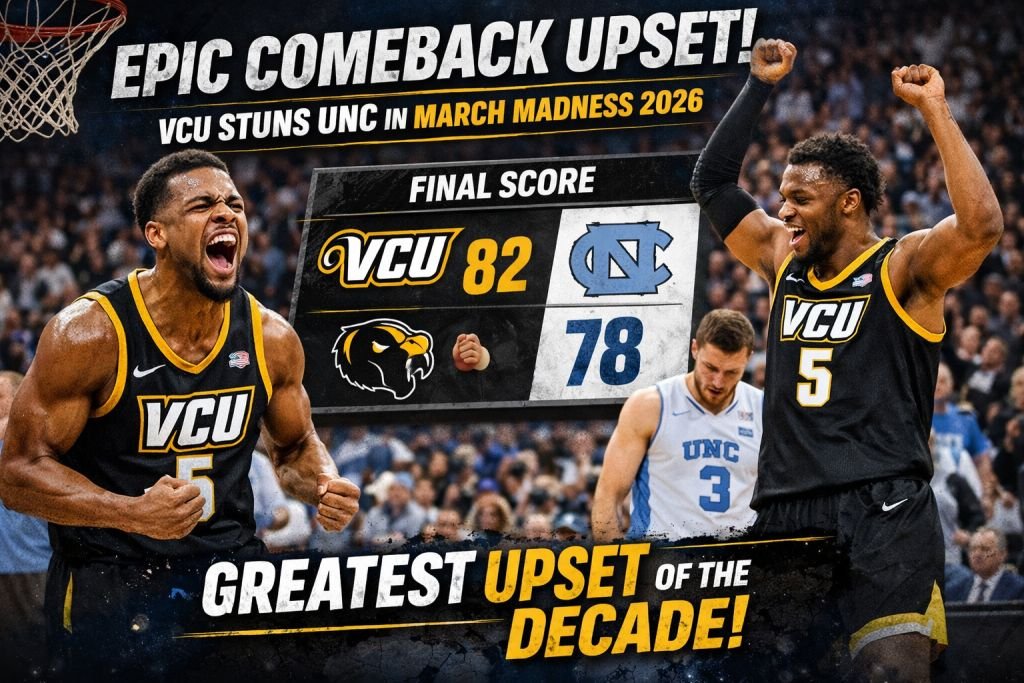
College basketball lives for moments like these. Late Thursday night in one of the most jaw-dropping games of the 2026 NCAA Tournament, the VCU Rams erased a 19-point deficit to knock off the North Carolina Tar Heels 82–78 — a comeback that will be replayed on highlight reels for years to come.
This was not just an upset. This was a resurrection. A program that began the night as a decided underdog turned in one of the most electrifying second-half performances in March Madness history, sparked by an unstoppable individual performance and fueled by one of the deepest benches in the tournament field.
If you blinked, you missed it. Here is the full story of VCU’s historic comeback over UNC.
The Setup: VCU vs. UNC in March Madness 2026
VCU entered the 2026 NCAA Tournament riding an exceptional 28–7 regular season record and a 15–3 mark in the Atlantic 10 — one of the most respected mid-major conferences in college basketball. Head coach Mike Rhoades had built a team defined by toughness, defensive pressure, and a depth chart that goes 10 players deep without a noticeable drop-off.
North Carolina, on the other hand, was a 24–9 ACC powerhouse and one of the most recognizable brands in all of college sports. The Tar Heels entered the tournament with the weight of history on their side — six national championships, a blue-blood recruiting pipeline, and a fan base that expects March runs as a birthright.
On paper, this looked like a manageable win for UNC. What unfolded was anything but.
First Half: UNC Builds a Mountain
The Tar Heels came out firing. UNC’s offense found early rhythm behind Henri Veesaar, the 7-foot Estonian center whose combination of interior dominance and perimeter shooting gave VCU’s defense no easy answers. The Tar Heels controlled the glass, executed their half-court sets with precision, and by the midpoint of the first half, they had begun to pull away.
UNC built their lead to 19 points — the largest of the game — before the break, as the Rams struggled to find offensive cohesion. VCU shot the ball inconsistently in the opening half, and North Carolina’s ability to generate second-chance points (12 for the game) extended possessions that should have belonged to the Rams.
At halftime, the scoreboard read UNC 39, VCU 35 — but the raw numbers do not capture how decisive UNC’s control had been at its peak. The Tar Heels’ biggest lead of 19 points had seemed like an insurmountable gap. Most teams do not come back from that in March.
VCU is not most teams.
The Turning Point: Terrence Hill Jr. Takes Over
If there is a single player who transformed this game, it is Terrence Hill Jr.
The VCU guard put on one of the most breathtaking individual performances of the 2026 NCAA Tournament, finishing the night with 34 points on 13-of-23 shooting, including an astonishing 7-of-10 from three-point range — a 70% clip from beyond the arc that defies belief in any context, let alone a hostile March Madness environment against a Power Conference opponent.
Hill did not just shoot well. He shot impossibly well. Seven threes in a do-or-die tournament game, each one more crucial than the last, each one landing at precisely the moment VCU needed a response. He also added 5 assists, 5 rebounds, and finished with a game-high efficiency rating of 32 — the best on the floor for either team by a wide margin.
His true shooting percentage of 71.2% was the exclamation point on an evening that may have announced him as the most exciting guard in college basketball not playing for a power program.
“He was unconscious,” one courtside observer noted after the final buzzer. “Every time they needed a bucket, he was there.”
The Second Half: VCU’s Bench Goes Nuclear
If Hill was the engine of VCU’s comeback, their bench was the rocket fuel.
The Rams finished the game with a staggering 42 bench points — a number that stands as a testament to the program’s extraordinary depth and Mike Rhoades’ ability to deploy his entire rotation without a drop in quality or intensity. While UNC’s bench managed just 7 points total, VCU’s reserves poured in buckets at every critical juncture of the second half.
Nyk Lewis added 16 points off the bench, shooting 62.5% from the field and converting at an 85.7% clip from the free-throw line down the stretch. His 3 steals and physical, relentless defensive pressure helped force the turnovers that swung the game’s momentum. Lazar Djokovic contributed 15 points and a steady presence in the frontcourt that allowed Hill to operate freely.
Michael Belle provided 8 points and 7 rebounds in a high-energy role that characterized VCU’s relentless style — versatile, physical, and never allowing UNC a moment to breathe or regroup.
The cumulative effect was suffocating. As VCU’s bench production surged in the second half, North Carolina’s rotations grew ragged. The Tar Heels’ offense, so fluid in the first half, became increasingly stagnant as the Rams’ defensive pressure took its toll.
UNC’s Collapse: What Went Wrong
To be fair to North Carolina, they played well enough to win this game for significant stretches. Henri Veesaar was exceptional, finishing with 26 points and 10 rebounds — a double-double performance that in almost any other game would have been enough. His 50% shooting from three (3-of-6) and ability to draw fouls in the post gave UNC a legitimate offensive anchor.
Seth Trimble added 15 points and an impressive 6 assists with just 1 turnover. Derek Dixon chipped in 11 points with a team-high 6 assists. The Tar Heels were not short on individual contributors.
The problem was collective. UNC’s bench managed only 7 points on the night — a catastrophic disparity against a VCU team that produced 42 off the pine. When the Tar Heels needed their reserves to provide spacing and energy in the second half, they got next to nothing.
North Carolina also shot just 27.6% from three-point range (8-of-29), a number that made their late-game attempts to slow the VCU avalanche nearly impossible. The Tar Heels needed perimeter shots to fall to maintain their lead as VCU’s defense tightened. They didn’t.
Free throw shooting was another fatal flaw. UNC converted just 60% from the charity stripe (12-of-20) in a game decided by 4 points. Those missed free throws, spread across the final ten minutes, were as responsible for the outcome as any VCU miracle shot.
By the Numbers: VCU vs. UNC Full Box Score Summary
| Stat | VCU Rams | UNC Tar Heels |
|---|---|---|
| Final Score | 82 | 78 |
| Field Goal % | 45.5% | 41.4% |
| Three-Point % | 42.3% (11-of-26) | 27.6% (8-of-29) |
| Free Throw % | 68.8% | 60.0% |
| Total Rebounds | 39 | 44 |
| Assists | 12 | 18 |
| Steals | 5 | 8 |
| Blocks | 5 | 1 |
| Bench Points | 42 | 7 |
| Biggest Lead | 4 | 19 |
| Points in Paint | 32 | 34 |
| True Shooting % | 56.1% | 49.5% |
| Effective FG % | 53.8% | 47.1% |
VCU’s Top Performers
Terrence Hill Jr. — 34 PTS | 5 AST | 5 REB | 13-23 FG | 7-10 3PT The performance of the tournament so far. Hill’s 70% three-point shooting in a comeback win for the ages will be the stuff of March Madness legend.
Nyk Lewis (Bench) — 16 PTS | 7 REB | 3 STL | 62.5% FG The engine of VCU’s bench explosion. Lewis was everywhere in the second half — scoring, defending, and making plays at the biggest moments.
Lazar Djokovic — 15 PTS | 5 REB | 2 BLK | 54.5% FG Steady, efficient, and imposing. Djokovic held his own in the frontcourt battle and came up big when VCU needed him most.
Brandon Jennings — 7 PTS | 6 REB | 2 BLK Quietly outstanding on the defensive end. Jennings’ 2 blocks and physical rebounding gave VCU the interior toughness to neutralize UNC’s paint advantage.
UNC’s Top Performers
Henri Veesaar — 26 PTS | 10 REB | 4 AST | 50% FG | 50% 3PT A genuine star performance in a losing effort. Veesaar was UNC’s best player by a significant margin and will enter next season as one of the ACC’s premier big men.
Seth Trimble — 15 PTS | 8 REB | 6 AST | 1 TO Trimble’s all-around game was impressive, but his team needed more from the rest of the roster to complement his effort.
Derek Dixon — 11 PTS | 5 REB | 6 AST A solid distributing performance that kept UNC’s offense organized — but the shots around him simply did not fall.
What This Means for VCU
For VCU’s program, this is a watershed moment. The Rams have a proud tournament history — including their remarkable Final Four run in 2011 — but knocking off a brand-name ACC program while trailing by 19 points in the NCAA Tournament is something else entirely.
Mike Rhoades has done a remarkable job building this roster, and the performance of his bench unit speaks to a program culture where everyone buys in, everyone prepares, and everyone contributes. In a tournament defined by individual star power and brand recognition, VCU’s team-first identity produced one of the night’s finest moments.
The Rams now advance and will face Illinois in the next round — a formidable opponent who demolished Penn 105–70 in their first-round matchup. Illinois will be heavily favored, but after Thursday night, nobody should underestimate what VCU is capable of doing.
The Bigger Picture: March Madness Delivers Again
This game was a reminder of why the NCAA Tournament holds a uniquely powerful grip on American sports culture. No other event produces moments like these — a mid-major team erasing a 19-point mountain against a blue-blood program, fueled by an incandescent individual performance and a bench that refused to accept the narrative the first half had written.
Terrence Hill Jr.’s 34-point explosion joins a long list of performances that defined March Madness. The name may not be as famous as others yet — but after Thursday night, everyone in college basketball knows who he is.
For VCU fans, this is one to remember forever. For North Carolina, it is a painful lesson that no lead is safe in March when an opponent has nothing to lose and everything to prove.
The madness continues.
What’s Next
VCU faces Illinois in the second round. Illinois enters fresh off a dominant 105–70 victory over Penn and will represent a significant step up in competition. But the Rams have demonstrated they are not intimidated by big names, big arenas, or big deficits.
North Carolina’s season ends here — a frustrating conclusion for a talented Tar Heels team that played well enough to advance but ran into one of the tournament’s great individual performances at exactly the wrong time.
Final Verdict
VCU’s 82–78 comeback win over North Carolina is already one of the defining games of the 2026 NCAA Tournament. A 19-point deficit erased. A bench that outscored the opponent’s reserves 42–7. And at the center of it all, Terrence Hill Jr. — a player who picked the biggest stage of his career to deliver the greatest performance of his life.
This is March Madness. This is why we watch.
About the Author